Composition
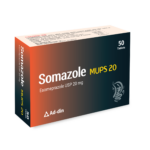
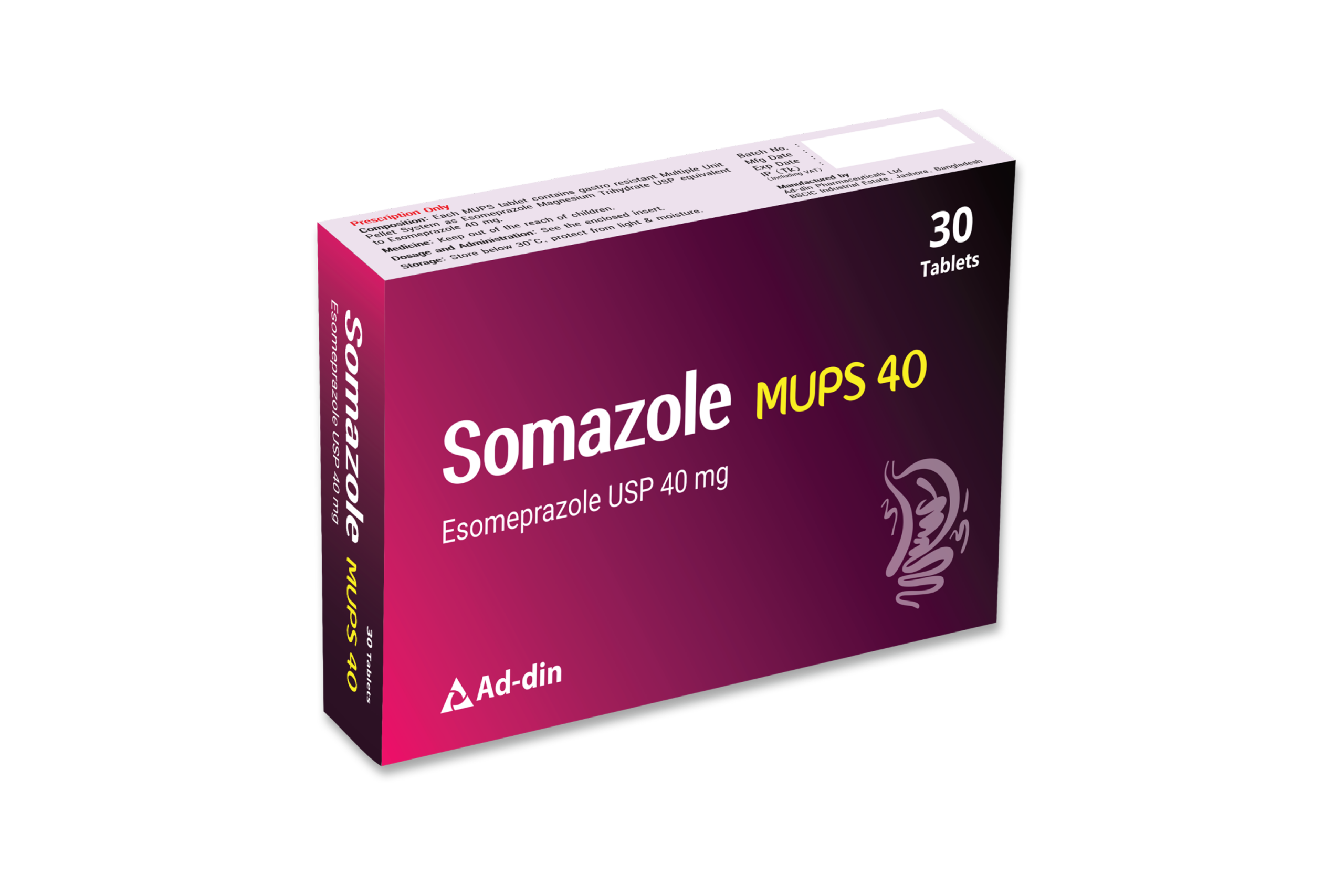
Each MUPS tablet contains gastro resistant Multiple Unit Pellet System as Esomeprazole Magnesium Trihydrate USP equivalent to Esomeprazole 40 mg.
Pharmacology
Somazole (Esomeprazole) is a proton pump inhibitor that suppresses gastric acid secretion by specific inhibition of the H+/K+-ATPase, the ‘Proton Pump’ of the gas tric parietal cell.
MUPS
MUPS refers to Multiple-Unit Pellet System. As a general matter, from the perspective of the pharmaceutical industry and research, MUPS is generally considered to be compacted into tablets. Thus, the resulting tablets prepared by compaction of modified release coated multi-particulates or pellets are called MUPS. This latest and most challenging technology combines the advantages of tablets and pellet-filled capsules in one dosage form.
Clinical Advantage of Somazole (Esomeprazole) MUPS Tablet Compared to Conventional Modified-Release Esomeprazole Tablets and Pellet-filled Esomeprazole Capsules
- Ensures better and more uniform drug absorption
- Ensures greater bioavailability
- Ensures uniform emptying of micro pellets from stomach into small intestine that facilitates rapid dissolution of enteric coating and drug release resulting in early T-max and C-max (peak time and peak plasma drug concentration)
- Ensures lesser possibility of dose dumping
- It is a combination of fast acting and sustained action
- Ensures uniform drug release
- It is better than capsules in reducing the esophageal residence time
- Minimizes fluctuation in plasma concentration of drug
Pharmacodynamic Advantages
Somazole (Esomeprazole) MUPS tablet ensures rapid and uniform gastric emptying and subsequently uniform drug dissolution of pellets in the gastrointestinal tract due to their small size and larger surface, uniform drug absorption is facilitated which results in consistent and controlled pharmacological action.
Indication
Somazole (Esomeprazole) is indicated
l Treatment of GERD
l Maintenance of healing of erosive esophagitis
l Risk reduction of NSAID’s associated gastric ulcer
l H. pylori eradication (triple therapy)
Dosage & Administration:
| Indication | Dose | Frequency |
| Adult: | ||
| Gastroesophageal Reflux Disease Healing of erosive sophagitis Maintenance ofhealing of erosive esophagitis Symptomatic GERD |
20 mg or 40 mg 20 mg 20 mg |
One daily 4 to 8 weeks One daily One daily 4 to 8 weeks |
| Risk Reuction of NSID associated gastric ulcer | 20 mg or 40 mg | One daily for up to 6 months |
| H.pylori eradication (Triple therapy) Esomeprazole Amoxicillin Clarithromycin |
20 mg 1000 mg 500 mg |
Twice daily for 10 days Twice daily for 10 days Twice daily for 10 days |
| Pediatric (12 years & older) Short term treatment of GERD |
20 mg or 40 mg | One daily for up to 8 weeks |
The majority of patients are healed within 4 to 8 weeks. For patients who do not heal after 4-8 weeks treatment may be considered.
or, as directed by the registered physician.
Contraindication
Esomeprazole is contraindicated in patient with known hypersensitivity to any of the ingrediants.
Warning & Precaution
Symptomatic response to therapy with Esomeprazole does not preclude the presence of gas tric malignancy.
Side effects
The mos t frequently occurring adverse effects reported with Esomeprazole include headache, diarrhoea, nausea, flatulence, abdominal pain, constipation and dry mouth.
Pregnancy & Lactation
There are no adequate and well-controlled studies in pregnant women. Animal studies have revealed no teratogenic effects. The excretion of esomeprazole in milk has not been studied. Breast-feeding should be therefore be discontinued if the use of esomeprazole is considered essential.
Use in Children
Effectiveness has not been es tablished in patients less than 1 month of age.
Drug Interaction
Esomeprazole is extensively metabolized in the liver by CYP2C19 and CYP3A4. In vitro and in vivo s tudies have shown that Esomeprazole is not likely to inhibit CYPs 1A2, 2A6, 2C9, 2D6, 2E1 and 3A4. No clinically relevant interactions with drugs metabolized by these CYP enzymes would be expected. Drug interaction s tudies have shown that Esomeprazole does not have any clinically significant interactions with phenytoin, warfarin, quinidine, clarithromycin or amoxicillin.
Esomeprazole may potentially interfere with CYP2C19, the major Esomeprazole metabolizing enzyme. Co-adminis tration of Esomeprazole 30 mg and diazepam, a CYP2C19 subs trate has resulted in a 45% decrease in clearance of diazepam. Increased plasma levels of diazepam have been observed 12 hours after dosing and onwards. Esomeprazole inhibits gastric acid secretion. Therefore, Esomeprazole may interfere with the absorption of drugs where gas tric pH is an important determinant of bioavailability (e.g., ketoconazole, iron salts and digoxin).
Co-adminis tration of oral contraceptives, diazepam, phenytoin, or quinidine do not seem to change the pharmacokinetic profile of Esomeprazole.
Combination therapy with Clarithromycin: Co-administration of Esomeprazole, clarithromycin, and amoxicillin has resulted in increases in the plasma levels of Esomeprazole and 14-hydroxyclarithromycin.
Overdose
A single oral dose of Esomeprazole at 510 mg/kg (about 103 times the human dose on a body surface area basis), has been lethal to rats. The major signs of acute toxicity are reduced motor activity, changes in respiratory frequency, tremor, ataxia, and intermittent clonic convulsions. There have been no reports of overdose with Esomeprazole.
No specific antidote for Esomeprazole is known. Since Esomeprazole is extensively protein bound, it is not expected to be removed by dialysis. In the event of overdose, treatment should be symptomatic and supportive.
Storage
Store below 30⁰C, protect from light & moisture. Keep out of the reach of children.
Packaging
Each box contains 30 MUPS tablet in Alu-Alu blister pack.